
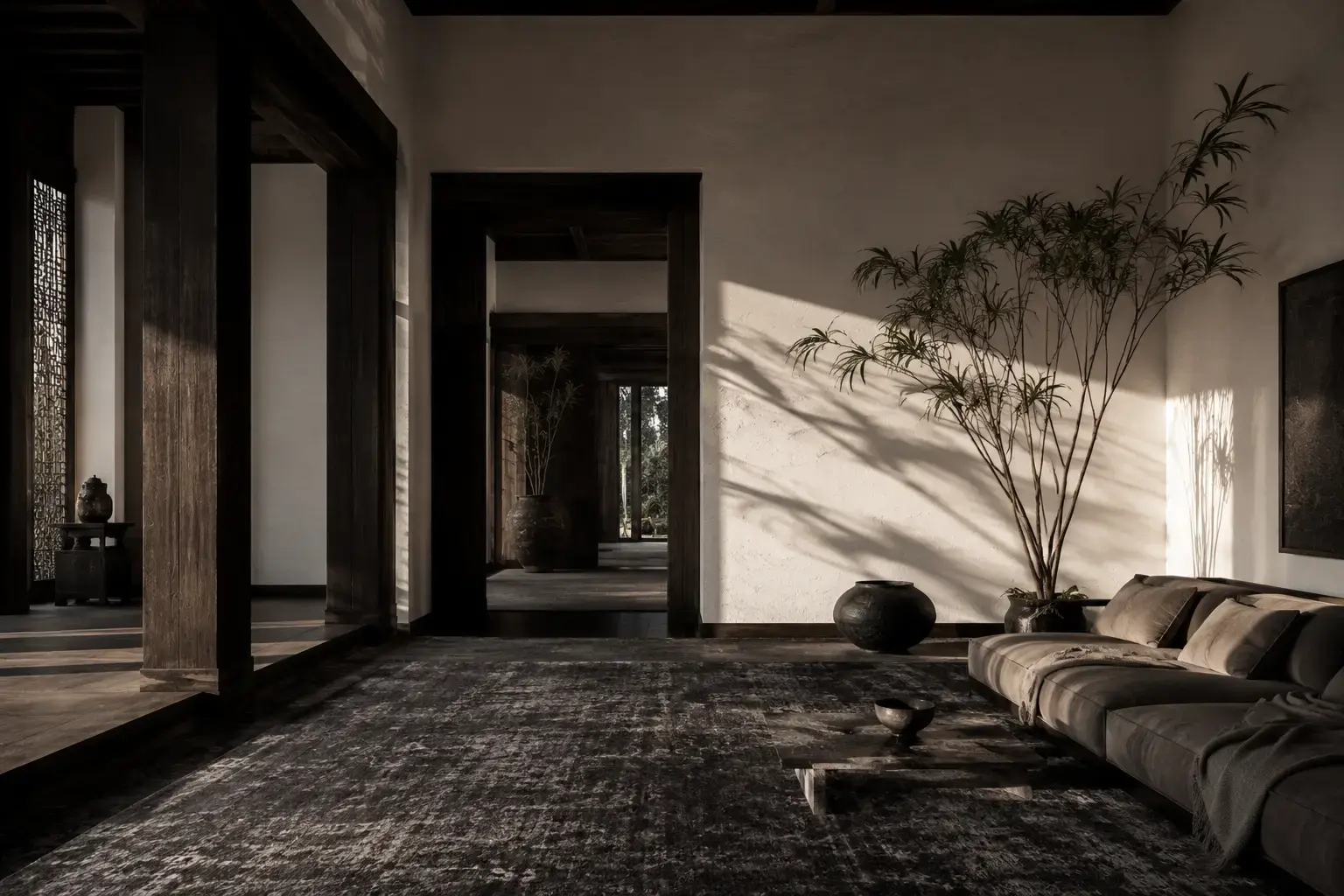
Indian homes are unlike any other in the world. We have marble floors that echo every footstep. We have homes where the dining table, the prayer area, and the workspace sometimes share the same room. We have monsoons and summers past 45°C. We have joint families, curious toddlers, and pets with muddy paws.
This guide is written specifically for Indian homes — taking into account our flooring, our climate, our family structures, and our aesthetic sensibilities.
Understanding Indian Flooring First
The vast majority of Indian homes use one of three types:
Italian or Indian Marble — Cold, hard, reflects sound. A rug is practically a necessity. Vitrified Tiles — Smooth, durable, slippery when wet. A rug pad is essential. Mosaic or Cement Tiles — Found in older homes. Slightly textured, naturally grips rugs.
In all cases, rugs serve critical functional roles: insulation, sound absorption, and space definition.
The Living Room
Your living room rug needs to be beautiful and resilient.
Material: New Zealand Wool is the best all-round choice — naturally stain-resistant, durable, temperature-regulating. Wool-silk blends add lustre. Avoid pure silk unless it's a low-traffic space.
Style: Bold geometrics for contemporary interiors. Subtle tonal abstracts for minimalist spaces. Rich jewel tones to contrast light marble. Choose the rug before cushion covers.
Size: 6×9 or 8×10 feet for most Indian living rooms (150-250 sq ft).
The Bedroom
Comfort takes absolute priority.
Material: High-pile wool for cloud-like softness. Bamboo silk for luminous texture. Cotton for children's rooms (washable and practical).
Style: Muted pastels, warm neutrals, monochromatic textures. Avoid busy patterns in a space that should feel serene.
Size: Place under the bed extending 60 cm on each side. Queen bed: 8×10 ft. King bed: 9×12 ft.
The Dining Room
Material: Flatweave or dhurrie — flat surface means chair legs glide without snagging. Easy to shake out crumbs.
Style: Darker palettes or busier patterns that camouflage stains. Avoid white or solid light colours.
Size: Must extend 60-75 cm beyond the table on all sides. 6-seater: 8×10 ft.
The Study / Home Office
Material: Low-pile wool or flatweave — office chairs need to roll freely.
Size: 5×7 or 6×9 feet under desk and chair.
The Pooja Room / Prayer Area
Material: Pure cotton dhurrie (washable, handles incense and turmeric) or silk for ceremonial rooms.
Style: Traditional motifs — paisleys, mandalas, lotus patterns. Auspicious colours: red, maroon, gold, saffron.
Size: 3×5 or 4×6 feet.
The Entryway and Hallway
Material: Tight flatweave for entryways (high-abuse zone). Wool runners for interior hallways.
Size: Runners should be half the width of the hallway, with 15-30 cm of bare floor at both ends.
The Balcony
Material: Jute, coir, or outdoor-rated polypropylene. Avoid wool and silk — sun fades dyes and moisture causes mildew.
Climate Considerations
Coastal Cities (Mumbai, Chennai, Kolkata): Use open-weave rug pads, lift rugs weekly during monsoon, run dehumidifiers, clean annually.
Dry Heat (Delhi, Jaipur, Ahmedabad): Vacuum twice weekly during dust season, UV-filter curtains, standard rotation.
Moderate (Bangalore, Pune, Hyderabad): Easiest climate. Standard weekly vacuum and seasonal rotation suffice.
The Investment Mindset
A machine-made rug at ₹8,000 replaced every 5 years = ₹40,000 over 25 years with nothing to show.
A hand-knotted rug at ₹50,000 is still in excellent condition after 25 years — possibly worth more than you paid. In Indian culture, we pass down gold, property, and sarees through generations. A hand-knotted rug belongs in that same category.
Final Thought
The best rug for your Indian home is one that respects the way you actually live. Choose materials that work for your climate. Choose sizes that work for your rooms. And above all, choose something that makes you feel something when you walk into the room. That's the point of a great rug. It doesn't just cover the floor. It completes the room.